
Pershing Projected Versus Actual Release
A projected date is a working estimate based on the active sentence structure and credits assumed at that point. An actual release date records a completed movement. They are not interchangeable. NDOC says its projected expiration remains a guide until the system locks an actual date roughly seven to ten days before release.
Pretrial custody is different. No sentence computation can forecast when a court will change bond, dismiss a case, or enter judgment. A court order may authorize release before jail staff complete administrative processing. For that reason, a projected Pershing County release date must always begin with the case and custody type.
- Projected expiration
- A conditional sentence estimate based on current assumptions.
- Parole eligibility
- The point when parole consideration may begin, not a release promise.
- Detainer
- A hold or request from another authority that may prevent community release.
- Actual release
- The recorded date a custody movement occurred.
Find a Pershing Projected Release
Pershing County has a county jail and a large state prison in Lovelock. The Sheriff is the custodian for local jail movement records. NDOC owns the sentence and release data for Lovelock Correctional Center. Confusing these facilities sends the request to the wrong office.
- Identify the facility and whether the case is pretrial, a county sentence, or a Nevada state-prison sentence.
- For county custody, obtain the judgment and ask the Sheriff for the individual sentence-credit ledger and release computation.
- For state prison, search the NDOC Offender Search by Offender ID when possible.
- Compare name, ID, approximate age, aliases, and sentence county before accepting a match.
- Review the Booking data’s raw date fields and the Release data’s actual release date and description.
- If parole applies, add the Board action, effective date, NPP placement approval, and NDOC actual release row.
The Pershing County released-inmate lookup covers the Sheriff and court routes in full. A person released from a short county-jail stay may never appear in NDOC. Conversely, transfer from the county jail to NDOC is continued custody, not a community release.
Nevada Prison Release-Date Credits
Through June 30, 2027, NRS 209.4465 generally allows an eligible person sentenced for an offense committed on or after July 17, 1997 and before July 1, 2027, twenty days per month for compliant conduct. Other possible credits involve work or study, outside programs, education, and exceptional meritorious conduct. Statutory limits determine whether and how credits affect a minimum term.
Nevada does not impose a universal rule that every prisoner serves 85 percent. Its framework uses judicial minimum and maximum terms. NRS 193.130 generally limits a felony minimum in relation to the maximum, subject to specified exceptions, while NRS 213.120 generally begins parole eligibility after the imposed minimum or minimum aggregate for covered offenses. Offense-specific law can change that result.
Effective July 1, 2027, NRS 209.4467 changes the credit framework, including a 35-percent model and possible election or comparison rules for certain earlier offenders. This is future law as of the research date. It must be checked again for calculations made after its effective date.
Note: NDOC credits and parole eligibility rules depend on offense date, sentence terms, and statutory limits, so one percentage cannot replace the official computation.
Why Pershing Release Dates Change
NDOC’s computer projection assumes maximum flat or statutory good-time and work credits, but not every meritorious credit. Credits post monthly. A change in sentence structure, conduct, another authority’s hold, or the parole process can move one milestone without moving all others.
| Factor | Possible effect | Record to check |
|---|---|---|
| Disciplinary forfeiture | Removes or delays assumed credit | NDOC computation and disciplinary record |
| Additional earned credit | May reduce an applicable term | Posted credit ledger |
| Consecutive or amended sentence | Changes the aggregate structure | Court judgment and NDOC computation |
| Detainer or hold | Can prevent community release | Holding and receiving agencies |
| Parole action | Creates or changes an eligibility and release path | Board action and effective date |
| Release-plan approval | Can delay physical release to parole | NPP Pre-Release Unit |
A grant of parole still is not physical release. NPP must approve the placement program. Residential confinement also demands care: a person can live outside an institution while remaining an inmate or while subject to parole or probation supervision.
Confirm a Pershing Actual Release
For state-prison history, the strongest public actual-release field is `release_date` in NDOC’s Release table, paired with `release_desc`. A discharged search result may show `INACTIVE-DSCHREL`, yet omit booking, image, hearing detail, or the reason a county stay ended. Raw data is a discovery tool, not a certified record.
For county custody, reconcile the Sheriff’s movement or release log with the court order. Ask whether Pershing custody ended in community release or transfer. For parole, follow the Board action through effective date and placement approval to the NDOC actual-release row and NPP supervision.
For supplemental notice, the current Nevada system is explained on the Pershing County VINELink inmate search page. Nevada S.A.V.E. replaced VINELink, and an alert still must be confirmed with the originating agency.
Pershing Jail Credit Ledger
Pershing County’s jail calculation is not the NDOC formula. County Code 13.30.060 allows up to five days per month for obedient, orderly, and faithful conduct. It adds tiered work credits based on sentence length: up to ten days for a term of 270 days or more, seven for 180 through 269 days, five for 30 through 179, three for 15 through 29, and none for a term under 15 days. Partial months are prorated.
The same section describes a five-day qualifying GED or equivalent credit and a five-day treatment-program credit for sentences of at least 90 days, plus forfeiture procedures. Section 13.30.040 permits up to five trustee-credit days per month for qualifying post-sentence misdemeanor or gross-misdemeanor time. It excludes presentence time and cannot run at the same time as work exchange.
Under Section 13.30.050, work exchange can credit one day of physical confinement for ten hours of public work, subject to eligibility and court limits. These are maximum or conditional rules. Ask the Sheriff for the individual ledger, judgment, and computation instead of doing confident calendar arithmetic.
Outside Pershing Jail Is Not Discharge
Pershing’s code distinguishes regular work or education release, trustee work, work exchange, and possible electronic supervision from final discharge. A person can be physically outside the jail while still serving a term. Pretrial electronic supervision also does not earn time-served credit under the codified local policy.
This distinction changes the verification question. Ask whether the person remains in jail custody, is on a structured release program, has completed the sentence, or moved to another authority. No official Pershing weekend or holiday early-release rule or standard release hour was found, so none should be inferred from staffing or general practice.
Pershing NDOC Sentence Date Fields
NDOC’s public Booking table does not display one friendly “Projected Release Date” column. It exposes raw fields. `sent_ped` is associated with parole eligibility, `sent_mpr` with mandatory parole release, and `sent_pexd` with projected expiration. `sent_rrd` should be described only as a release-related field unless NDOC documentation or the displayed record confirms its expansion.
The official search image below shows the Offender ID and name inputs used to reach those state records.
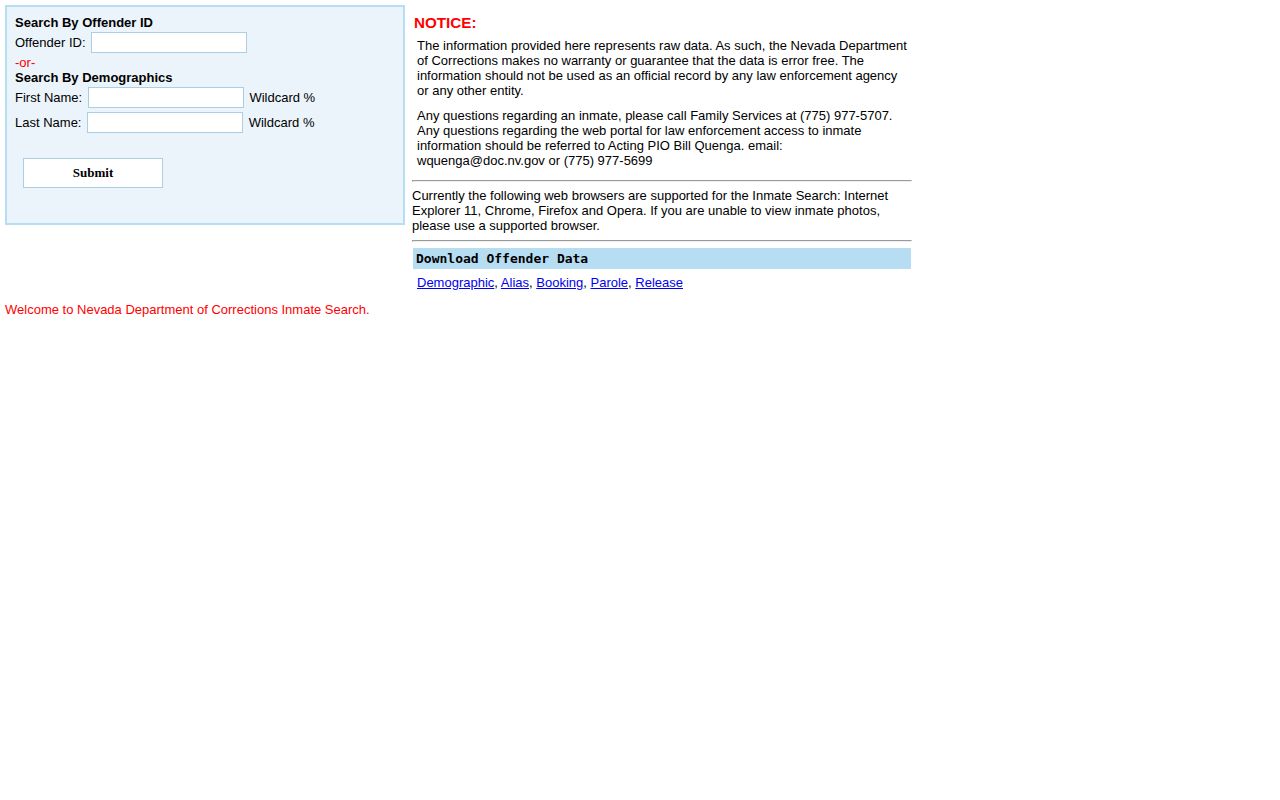
Use the Offender ID when possible, then match the sentence and booking rows before interpreting any date.
Review a Pershing Release Computation
Start with the judgment because the calculator cannot correct a wrong sentence premise. Record each minimum and maximum term, whether terms run together or one after another, the sentence start date, and credit for time served. Then compare those facts with the jail or NDOC ledger. More than one booking or sentence row may exist, so the first search result is not always the controlling term.
For a state-prison calculation, separate four kinds of dates before asking why they differ: parole eligibility, mandatory parole release, projected expiration, and actual release. A Board eligibility list or hearing calendar does not replace any of them. The Board decides parole, NDOC computes sentences and records prison release, and NPP approves a placement and supervises parole. Each agency should be asked only for the record it owns.
For a Pershing County Jail sentence, request the individual credit ledger rather than applying the maximum credits to every month. Conduct credit is conditional. Work, trustee, education, treatment, and work-exchange credits have separate eligibility rules and can be forfeited or barred from overlapping. Presentence credit comes from the judgment or court calculation and should not be treated as trustee time.
When two records disagree, note when each was created and whether it is an estimate or completed event. A later amended judgment can change the sentence. Monthly credit posting can move an estimate. A detainer can change the destination without changing the date Pershing custody ends. An actual release row can document movement but still require `release_desc` to determine whether the person entered the community, parole, or another status.
Formal disputes need an official time computation. NDOC’s search form calls its display raw data and offers no warranty that it is error free. The public fields are useful for discovery and comparison, but they should not be promoted to a certified sentence record. Keep the Offender ID, booking ID, sentence county, court case number, and release description with the request so staff can identify the correct term.