
Pershing Parole and Probation Compared
Nevada divides the work. The Nevada Board of Parole Commissioners makes parole decisions. The Nevada Department of Public Safety, Division of Parole and Probation, called NPP, investigates release plans and supervises both parolees and probationers. The Nevada Department of Corrections, or NDOC, confines state prisoners and computes sentence dates. A Pershing County inquiry can require records from all three.
Parole is conditional release from a state-prison sentence. It does not erase the sentence. Probation is a court-ordered period of community supervision and may occur without a state-prison stay. The sentencing court owns the probation order and final completion record, while NPP performs the field supervision.
| Point | Parole | Probation |
|---|---|---|
| Who authorizes it | Nevada Board of Parole Commissioners | Sentencing court |
| What comes before | Part of a state-prison sentence | A criminal judgment, often without prison release |
| Who supervises | NPP | NPP |
| Best end record | Honorable or dishonorable discharge | Court discharge or completion order |
- Parole
- Conditional community release during a prison sentence.
- Probation
- Court-ordered supervision in the community.
- Discharge
- The formal end of a supervision term.
- Residential confinement
- Placement outside an institution while legal custody or supervision continues.
Verify Pershing Post-Release Supervision
No official statewide NPP person-name lookup was found in the research completed July 28, 2026. That makes a careful record chain more useful than a single search. NDOC data may show a parole row, but NDOC warns that it is not the current source for parolee or probationer supervision.
- Identify parole or probation from the judgment, NDOC status, or Board record. Do not infer it from physical location.
- For parole, check the hearing calendar and then the monthly action report. A calendar entry is not a release decision.
- Match the NDOC ID, name, location, commit county, action, and action date. Similar names require more than a name match.
- Ask NPP whether active supervision can be confirmed and which office is responsible. Protected details may not be disclosed.
- For probation, obtain the sentencing court order and later discharge or completion order.
- For a completed term, request the formal discharge rather than relying on an old portal label.
The NDOC Offender Search is still useful for identity and state-prison history. An inactive discharged record can remain there after release. Yet it does not cover a probation-only case or every short Pershing County Jail stay. The broader Pershing County released-inmate search path explains how Sheriff and court records fill those gaps.
Pershing Supervision Uses Winnemucca
Pershing County falls within NPP Northern Command. The practical field route is the Winnemucca office. Call to ask whether staff can confirm active supervision, identify the right reporting office, or explain the proper records-request channel. NRS 213.1075 can protect detailed supervision records, so a caller should not expect a home address, risk assessment, conditions, or case notes.
3505 Construction Way
Winnemucca, NV 89445
Phone: (775) 623-6540
Fax: (775) 623-6542
The official NPP contact directory confirms the Northern Command route. Headquarters is at 1445 Old Hot Springs Road, Suite 104, Carson City, with phone (775) 684-2600. No local public-person lookup replaces direct confirmation.
The source image below shows the official Northern Command contact route.
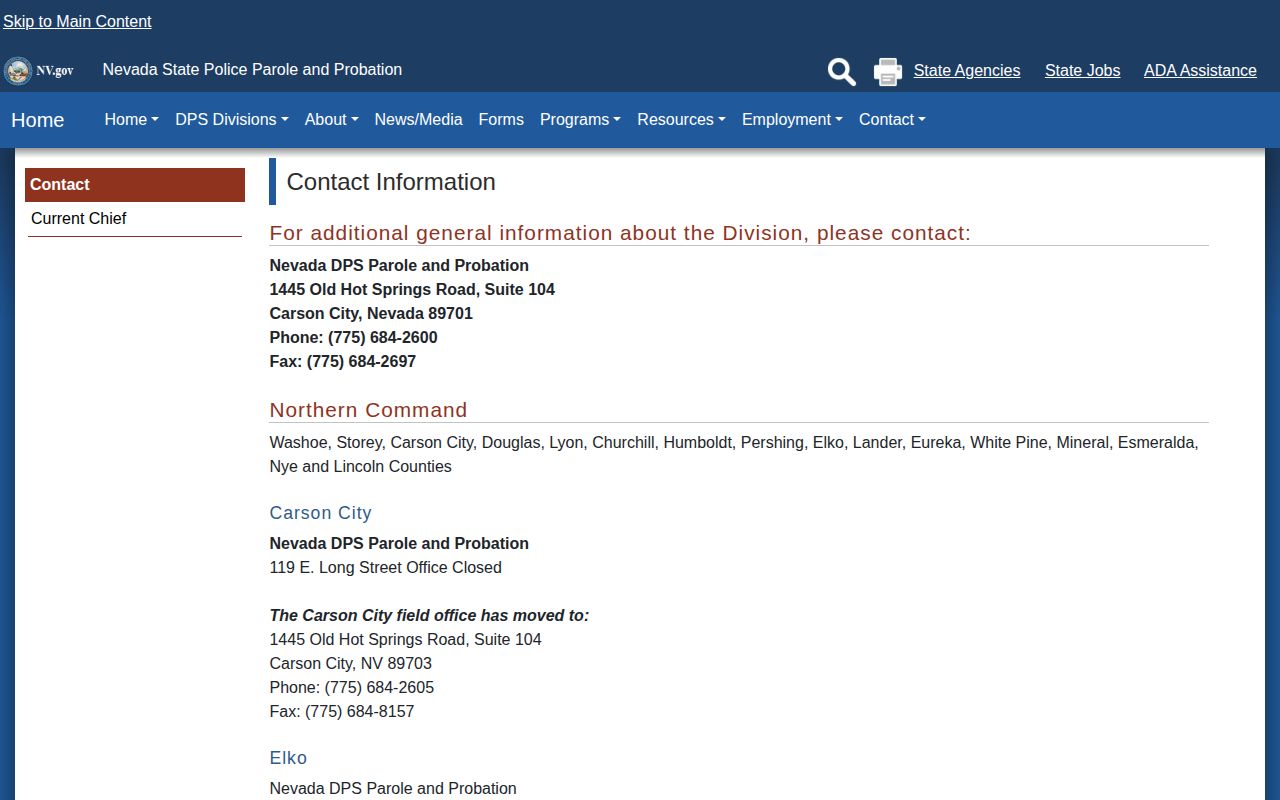
Use the Winnemucca listing for Pershing supervision questions, not as proof that a named person is supervised.
Pershing Supervision Violations and Warrants
Conditions can require reporting, approved residence, travel limits, treatment, or other conduct set by the court, Board, and NPP. The exact terms belong to the individual order. A suspected breach is not the same as a formal violation finding, and an arrest after release starts a new custody episode that needs its own verification.
NPP has a Wanted Fugitives area, but it displayed no entries on the research date. Old flyers are not safe proof of a current warrant. NRS 176A.400 defines probation absconding in part as actively avoiding supervision while whereabouts remain unknown for a continuous period of at least 60 days. One missed check-in should not be relabeled as legal absconding.
For parole, compare violation agendas and monthly actions. “Revoke Parole,” “Continue on Parole,” and revoke-and-reinstate actions have different effects. Then check NDOC status, the local jail, and any new court record. Phone-confirm a claimed warrant with the responsible authority.
How Pershing Supervision Ends
A move from Lovelock Correctional Center to parole is a release from confinement, not completion of the sentence. Under NRS 213.154, expiration of the parole term leads to an honorable or dishonorable discharge. That document is stronger evidence that supervision ended than a stale NDOC or notification label. For probation, the sentencing court’s discharge or completion order is the key record.
Public access has limits. Nevada’s public-record framework favors access under NRS Chapter 239, but it does not override privileged parole and probation information. Ask for a specific, segregable record such as a final action or discharge. If access is denied, request the exact legal basis instead of assuming the whole file is public.
Note: Physical release, active supervision, and final discharge are three separate milestones, each proved by a different record.
Pershing Parole Decisions Are Not Releases
The Board calendar, monthly eligibility list, and monthly action report serve different purposes. NDOC creates the eligibility list for scheduling. It is neither a decision nor proof of release. A hearing entry can also change if a person moves or loses eligibility. Monthly actions report results, including grant, deny, revoke, continue, early discharge, and no action.
Even “Grant Parole” does not prove that a person walked out that day. NPP’s Pre-Release Unit investigates residence plans, interstate compact matters, and placement. Its official rule is direct: physical release to parole cannot occur until the placement program is approved.
The sound chain is calendar, monthly action, effective date, approved placement, NDOC actual release row, then NPP supervision. The following official image provides the placement-approval context.
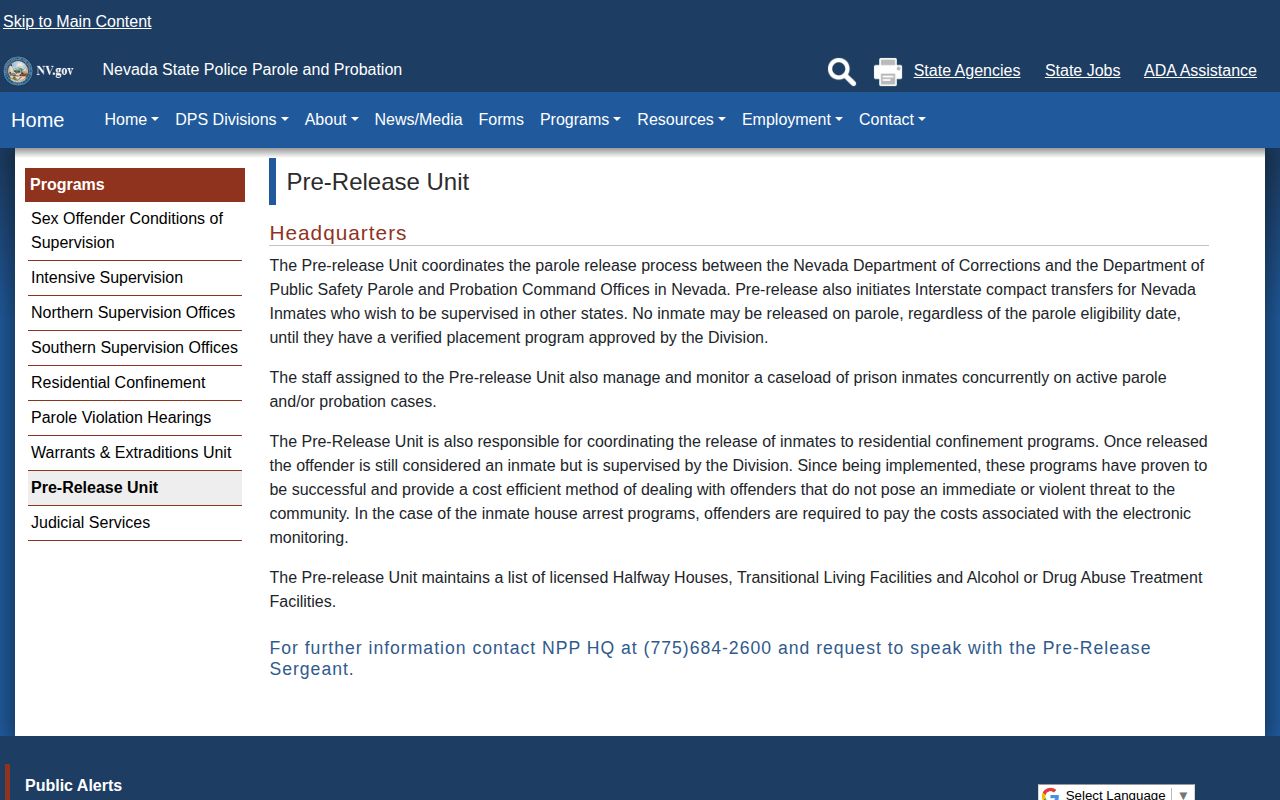
It shows why a favorable Board result still needs release-plan processing before physical movement.
Reentry After a Lovelock Release
Lovelock Correctional Center materials identify RESPECT as a reentry program and Coal Canyon High School with the Pershing County School District as an education provider. Board minutes also describe reentry resource fairs and community-living work. These are navigation points for people leaving the state prison, not promises of eligibility, enrollment, or results.
The distinction matters locally because Lovelock also has the Pershing County Jail. LCC programs belong to the NDOC state-prison route. A person leaving the county jail should not be told that the same program or parole process applies. The source facility, judgment, and agency control the next step.
State-Prison Release ID and Travel
NRS 209.511 covers state-prison release logistics. When requested and needed, NDOC provides photo identification and reasonable help with DMV identification. The law also addresses suitable clothing, transportation cost to a residence within the continental United States or the place of conviction, transition placement, prescribed medication, and possible funds based on need.
Nevada DMV Form 013 explains an identification-document and fee-waiver path for a person recently released from incarceration. These provisions concern an LCC or other NDOC release. They do not prove that Pershing County Jail follows the same policy, and they do not establish that any one person received each form of aid.
Pershing Parole and Probation Records
Each record answers only part of the supervision question. A Board hearing schedule shows planned consideration. The monthly eligibility list shows that NDOC identified a scheduling candidate. A monthly action shows what the Board did, subject to concurrence, ratification, notice, and the listed effective date. NDOC’s Release data can then document the physical state-prison movement. NPP confirms the supervision route and approved placement.
Probation follows a shorter chain because the court, not the Board, imposes it. Start with the judgment, read the terms and reporting agency, and obtain later orders that change, revoke, or complete probation. Lake Township Justice Court handles lower-level and initial matters, while felony judgment and sentence records belong in the Eleventh Judicial District Court. A court order controls the legal status even when an online custody display has not caught up.
A parole hearing is commonly scheduled before the minimum parole-eligibility date, but scheduling is not a promise. NRS 213.120 gives a general first-eligibility rule, while NRS 213.1212 through 213.1215 and offense-specific statutes can alter it. The Board does not calculate sentence dates. Questions about the computation belong with NDOC, while questions about placement approval or release to parole belong with NPP.
Records can also conflict because they update on different schedules. Resolve the conflict by date, source, and event. A newer formal discharge outranks an old active label. An actual NDOC release row is stronger proof of movement than an eligibility list. A current court revocation order can create a new custody episode after an earlier release. Keep the Offender ID, court case number, action date, and release date together so records for similar names do not get mixed.