
Lovelock Correctional Center Releases
Lovelock Correctional Center, or LCC, is a Nevada Department of Corrections state prison. It does not operate as the Pershing County Jail. A person can leave LCC through discharge at sentence expiration, release to parole, residential confinement, or transfer to another NDOC institution or authority. Each movement has a distinct meaning. A transfer remains custody, and residential confinement can place an inmate outside an institution while supervision and sentence status continue.
NDOC owns the offender and release record. The Board of Parole Commissioners decides discretionary parole. NPP investigates and approves the release plan, then supervises parolees. NDOC specifically routes questions about plan approval and the date of release to parole to NPP’s Pre-Release Unit. A Board grant, effective date, and approved placement all matter, but NDOC’s actual release row or direct agency confirmation establishes the completed movement.
| LCC movement | What it means | Primary proof |
|---|---|---|
| Sentence discharge | The state-prison custody term ended as recorded. | NDOC Release row and discharge record |
| Release to parole | The person entered conditional community supervision. | Board action, approved NPP plan, NDOC release row |
| Residential confinement | The person may live outside prison while remaining an inmate under supervision. | NDOC and NPP status |
| Institutional transfer | Custody continued at another site. | NDOC institution or status field |
Confirm an LCC Release
Open the NDOC Offender Search. Use the Offender ID when possible. For a name search, enter first and last name; `%` is the portal’s wildcard. Compare age, aliases, physical details, sentence county, and status across plausible matches. Do not match a record by name alone.
- Find the correct NDOC identity and record the Offender ID.
- Read the Institution field. An inactive result may display `INACTIVE-DSCHREL`.
- Match the ID in NDOC’s downloadable Release table and read `release_date` with `release_desc`.
- Use Booking and Parole data to distinguish the relevant term, sentence fields, and hearing entry.
- If parole applies, confirm the Board action and NPP plan before treating a proposed date as completed release.
NDOC calls the public display raw data and does not guarantee that it is error free. A tested discharged record lacked booking, photo, and parole-hearing details even though its inactive code remained visible. Use the portal as a discovery tool, then request the official offender or release record when the answer must be formal.
LCC Release Data Fields
NDOC publishes separate Demographic, Booking, Parole, and Release files. The Offender ID and offender booking ID connect them. The Release file gives the strongest direct public history through `release_date` and `release_desc`. The Booking file can retain the sentence county, term lengths, sentence start, and raw date fields after the person leaves prison.
| NDOC field | Use |
|---|---|
| `offender_id` | Matches one identity across NDOC tables. |
| `offender_book_id` | Distinguishes booking or sentence episodes. |
| `release_date` | Records the actual date tied to that release row. |
| `release_desc` | States the agency’s release or movement description. |
| `sent_ped` | Sentence parole-eligibility-date field, not guaranteed release. |
| `sent_mpr` | Mandatory-parole-release field. |
| `sent_pexd` | Projected-expiration field that can change. |
Report a release description as NDOC uses it. A row observed during research contained the apparent typo `TRANSER TO PAROLE`; its meaning is transfer or release to parole, not unconditional sentence completion. One person can have several bookings and sentence rows, so the first date found may not belong to the term being researched.
Request LCC Release Records
For offender records, contact NDOC Offender Management at omdrecords@doc.nv.gov or mail P.O. Box 7011, Carson City, NV 89702. Give the full name, Offender ID, booking ID if known, and the exact release entry, date, description, discharge document, sentence computation, or identification photo sought.
A Chapter 239 request can go to publicrecords@doc.nv.gov or through the NDOC records and information route. NDOC lists (775) 977-5649 for public-record questions. Inspection is available Monday through Friday from 8 a.m. to 5 p.m. Its listed paper fee is $0.15 per page, with specified media, shipping, and extraordinary-use costs. Those are record-copy fees. NDOC’s FAQ separately states that an offender is charged no fee upon release.
NDOC Administrative Regulation 120 states that identification photos, if available, are public information, but an older inactive profile can show that no photo is available. Ask for the record held rather than assuming every historical image survives.
LCC Parole Is Not Release
The Nevada Board’s monthly eligibility list identifies people NDOC has placed in the scheduling stream. It is not a decision. A hearing calendar shows planned consideration, and a monthly action report records what the Board did. Actions can include grant or deny parole, grant or deny mandatory parole release, revoke, continue on parole, early discharge, or no action.
A grant still does not equal the moment of release. NPP’s Pre-Release Unit must approve the placement program before an inmate can physically release on parole. Residential plans, interstate compact work, and residential confinement can affect timing. The best chain is Board action, effective date, NPP placement approval, NDOC actual release row, then NPP supervision confirmation.
NPP Northern Command serves Pershing County. Its practical field office is at 3505 Construction Way, Winnemucca, NV 89445, phone (775) 623-6540. No official statewide public NPP person-name lookup was found. Detailed supervision files may be privileged, so ask what status or records route the office can lawfully confirm.
LCC Projected Release Dates Change
NDOC’s projected expiration is conditional. Its calculation can assume statutory and work credits, while other credits post later. Discipline, forfeited credits, added credits, sentence changes, consecutive terms, detainers, and plan approval can move the milestones. The estimate remains a guide until NDOC locks an actual date close to release.
Nevada does not impose a universal rule that every state prisoner serves 85 percent. Judicial minimum and maximum terms, offense-specific laws, sentence credits, parole eligibility, and Board action shape the result. Through June 30, 2027, NRS 209.4465 governs the main current credit framework described in the research. NRS 209.4467 changes the framework on July 1, 2027 and must be rechecked after it takes effect.
Can a projected date prove release? No. Use it as an estimate, then look for the NDOC Release row and any NPP approval needed for parole.
LCC Release ID and Transportation
Nevada law supports several state-prison release logistics. Under NRS 209.511, NDOC preparation can include requested or needed photo identification, reasonable assistance with a DMV identification card, suitable clothing, transportation cost to a residence within the continental United States or the place of conviction, an appropriate transition placement, prescribed medication, and up to $100 based on need.
Nevada DMV Form 013 describes documentation for someone released from prison within 90 days and a fee-waiver request. These provisions do not guarantee that each person receives every item. They also apply to the NDOC path, not to someone leaving Pershing County Jail. Ask LCC or NDOC which release preparation applies to the individual case.
LCC Reentry Programs and Limits
LCC budget materials identify RESPECT as a reentry program and Coal Canyon High School with the Pershing County School District as an education provider. Board of Prison Commissioners minutes also describe a community-living unit and reentry resource fairs. These details can guide a question to facility staff about resources connected to a release plan.
They do not promise enrollment, eligibility, or a specific result. Program participation is also not a discharge record. NDOC still computes sentence dates, the Board still controls discretionary parole decisions, and NPP still handles placement approval and supervision. Keep the program record separate from the official custody movement.
Lovelock Prison History and Capacity
The official LCC facility page says the prison opened in phases beginning in August 1995. It expanded to an approximate budgeted capacity of 1,680 and houses medium-custody general population, close-custody protective segregation, and a small minimum-custody population.
The official NDOC view below identifies Lovelock Correctional Center as a state facility.
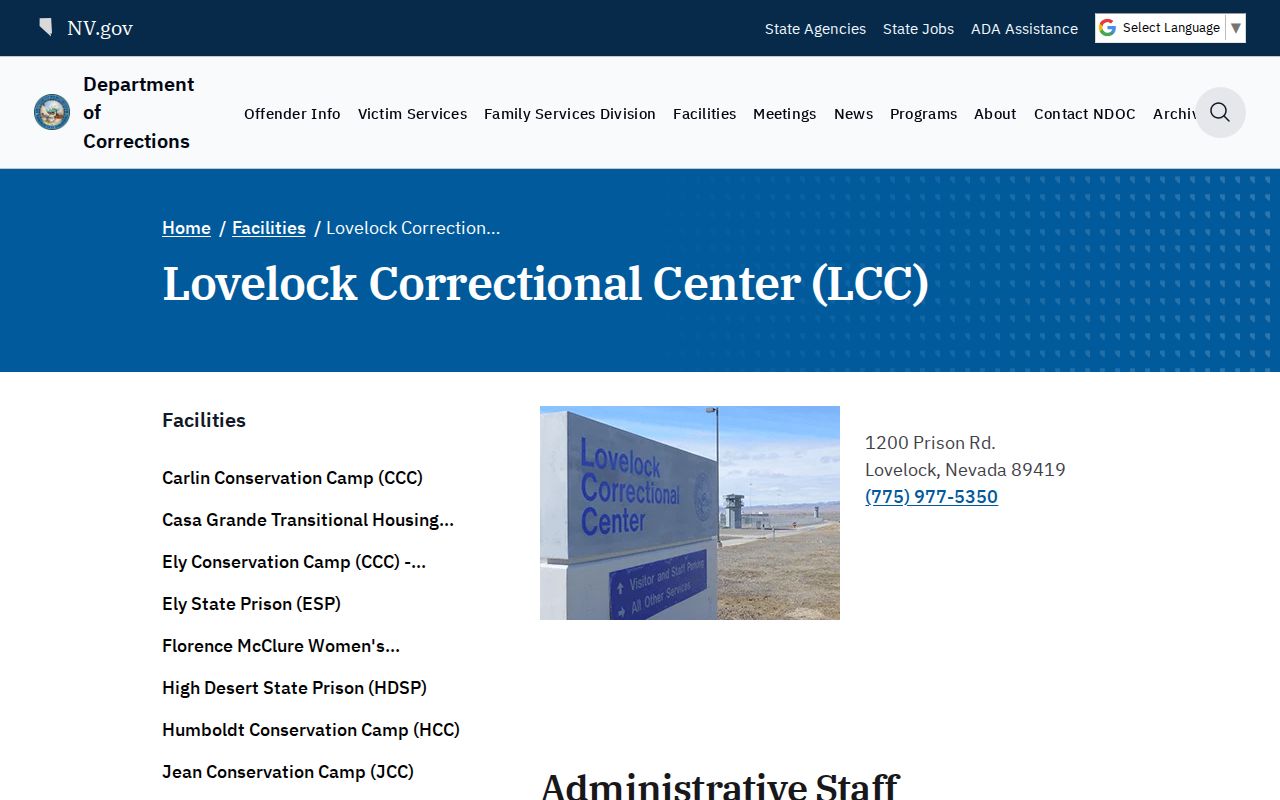
Lovelock also contains the county jail, but the facilities serve different populations and record systems. The Pershing Sheriff handles local jail movements. NDOC handles LCC release and discharge. A “Lovelock released inmate” search must identify which facility held the person before any roster or release result can be read correctly.
Verify the LCC Release Record
Match the Offender ID first. Then read the NDOC status, Release row, and description. If parole is involved, add the Board action and NPP placement approval. If the record shows transfer or residential confinement, do not call it unconditional community discharge.
The Pershing County release records hub separates LCC from the county jail and federal systems. For LCC itself, NDOC remains the records custodian, even though the prison stands in Pershing County.